最后更新:2026-08-10 作者 阅读时间:5分钟

Nitrogen vs Oxygen vs Air: Laser Cutting Assist Gas Guide

Assist gas is the biggest operating cost on most fiber lasers after electricity, and the least examined. Shops inherit a gas habit with the machine, run it for years, and never do the math on whether nitrogen's premium edge, oxygen's speed, or air's near-zero cost actually fits the parts going out the door. This guide is the decision framework: what each gas does, an edge-quality comparison across mild steel, stainless, and aluminum, the cost-per-part math, and the pressure numbers by thickness.

Which Assist Gas Should You Use?

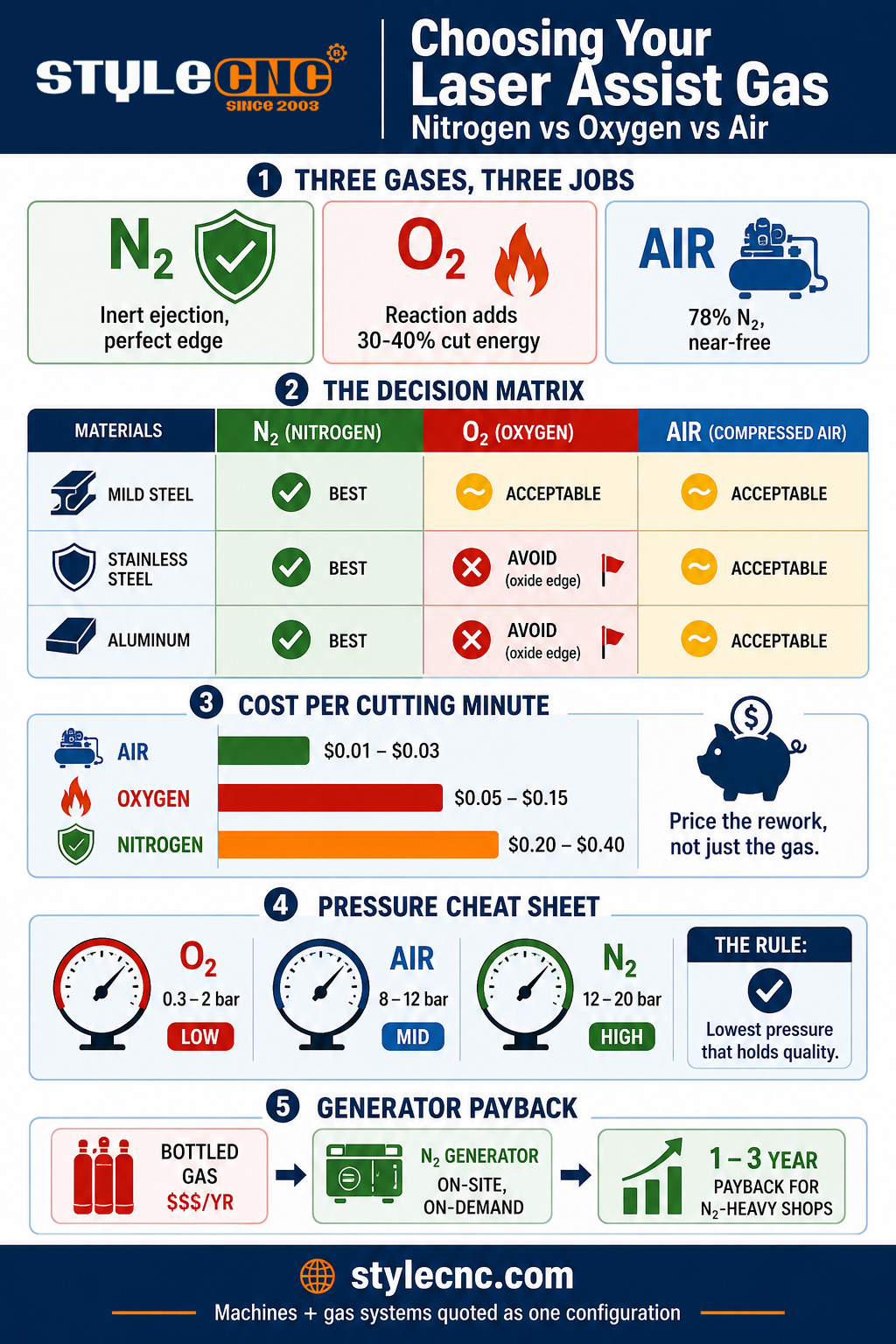
Use oxygen for carbon steel over 6 mm, where its exothermic reaction adds cutting energy at low pressure and low cost. Use nitrogen for stainless steel, aluminum, and any edge that must be oxide-free and weld-ready, at 12 to 20 bar. Use dried, oil-free compressed air for thin-to-medium mild steel and non-cosmetic work, where its near-zero cost beats its slightly oxidized edge.

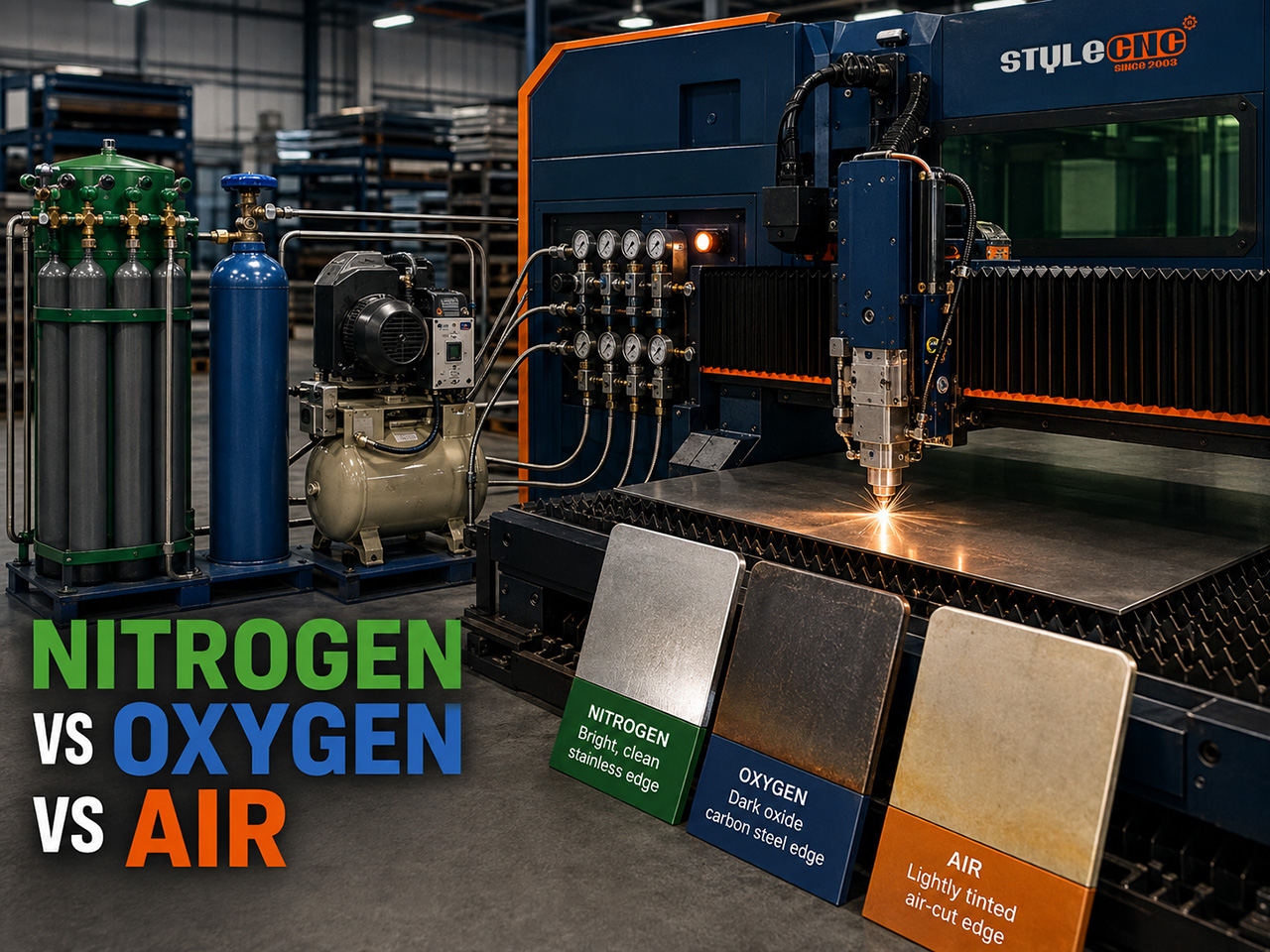
Assist gas does 2 jobs. Mechanically, it blasts molten metal out of the kerf before it re-solidifies, which is what edge quality mostly depends on. Chemically, it either feeds the cut or protects it: oxygen reacts with hot iron and contributes roughly 30 to 40 percent of the total cutting energy on carbon steel, while nitrogen stays inert and leaves the cut face exactly as the beam made it. Air, being 78 percent nitrogen and 21 percent oxygen, does a diluted version of both at once. Every selection decision is a trade between those chemistries and their very different costs.

Nitrogen vs Oxygen vs Air: Laser Cutting Assist Gas Guide

The Comparison: Edge Quality, Speed, Pressure, and Cost

The table below compares the 3 gases across the factors that decide real purchasing and quoting. The Measurement row states the basis so the numbers are comparable rather than brochure-vague.

因素氧气压缩空气
多维数据监测Typical 1 to 6 kW fiber, 1 to 12 mm sheet, production settingsSame basis, carbon steel focusSame basis, oil-free dried air
切割机构Inert melt ejection onlyExothermic reaction adds 30 to 40% of cut energyDiluted both (78% N2, 21% O2)
工作压力12到20吧0.3到2吧8 to 12 bar (boosted to ~17)
气体流量300 to 500+ L/min20 至 60 升/分钟Compressor-supplied, high volume
Cost per cutting minute$0.20 to 0.40 (0.60+ high-pressure)$0.05到0.15$0.01 to 0.03 (electricity)
Mild steel edge光亮、无氧化物、可焊接Fast cut, dark oxide layerLight oxide tint, good for its price
Stainless steel edgeBright, paint- and weld-ready (the standard)Contaminated chromium oxide edge; avoidSlight yellowing; acceptable non-cosmetic
Aluminum edgeClean, anodize-ready (the standard)Hard oxide, rough edge; avoidAcceptable thin sheet with gray tint
Speed characterFastest on thin sheet, power-limited on thickFastest on thick carbon steelNear-nitrogen on thin gauges
最适合Stainless, aluminum, cosmetic and weld-prep workCarbon steel 6 mm and upThin-to-medium mild steel, high-volume budget work

The stainless row deserves its own warning. At cutting temperature, even trace oxygen reacts with the chromium in stainless steel and leaves a contaminated oxide edge that rejects paint and compromises welds. That is why nitrogen is not a preference on stainless but the standard, and why the honest cost comparison includes rework: expensive nitrogen is cheap next to fabricators grinding oxidation off a thousand brackets.

The Cost-per-Part Math

Work the numbers on a concrete part: a bracket with 60 seconds of cut time in 2 mm sheet, quoted at 1,000 pieces.

氧气: At $0.05 to 0.15 per cutting minute, gas adds about $0.05 to 0.15 per part, or $50 to 150 across the run. The edge carries an oxide layer that must be cleaned before welding or powder coat.

: At $0.20 to 0.40 per minute, gas adds $0.20 to 0.40 per part, $200 to 400 per run. The edge is finished as cut: no deburr-and-degrease step, straight to weld or coat. If oxide removal would cost even 20 seconds of labor per part, nitrogen wins the total math despite the higher gas line.

压缩空气: At $0.01 to 0.03 per minute of compressor electricity, gas adds $0.01 to 0.03 per part, $10 to 30 per run, after a one-time $5,000 to 20,000 investment in an oil-free compressor, dryer, and filtration train. For mild steel parts that get painted anyway, this is the cost floor of the industry.

Scale changes the answer again. A 2-shift operation cutting nitrogen-heavy work can burn 6 figures annually in bottled or bulk gas, which is the classic justification for an on-site nitrogen generator; payback commonly lands in 1 to 3 years at that consumption. And avoid the purity trap while you are at it: assist gas does not need laboratory 5-nines purity for mild steel work, and paying for it is money vented through the nozzle.

Assist Gas Pressure by Thickness

Pressure setting follows the material and gas, rising with thickness for nitrogen and falling with thickness for oxygen. Starting windows for fiber laser work:

材质及厚度煤气启动压力
Mild steel 1 to 6 mm空气或氮气8 to 12 bar (air) / 10 to 14 bar (N2)
Mild steel 6 to 20 mm氧气0.5 to 2 bar, falling as thickness rises
Stainless 1 to 6 mm10到16吧
Stainless 6 to 12 mm16 to 20 bar, larger nozzle
Aluminum 1 to 6 mmNitrogen (or air, thin)12到16吧
Aluminum 6 to 12 mm16 to 20 bar, negative focus

2 consumption habits protect the budget. Use the lowest pressure that holds edge quality, because flow and cost rise steeply with pressure and nozzle diameter. And keep nozzles centered and matched to thickness: a misaligned or oversized nozzle can vent double-digit dollars per hour without improving the cut at all.

Gas is a input among several that set final cut quality; the fiber laser performance factors guide covers how pressure interacts with focus, nozzle standoff, and speed, and the CO2 laser cutting parameters reference carries the settings-level detail for CO2 platforms, where the same 3 gases apply.

Matching the Gas System to the Machine

Gas strategy is a configuration decision, not an afterthought. Nitrogen-heavy stainless work needs the high-pressure gas circuit, proportional valve, and nozzle library that the 不锈钢激光切割机 configuration is built around. Air-primary shops need the compressor, dryer, and filtration specified with the machine rather than bolted on later. Tell the STYLECNCteam your material mix and monthly cutting hours, and the gas system, generator-vs-bottled recommendation, and machine configuration come back as one matched quote.

Nitrogen vs Oxygen vs Air: Choosing the Right Assist Gas for Laser Cutting Metal

常見問題解答

What is the difference between nitrogen and oxygen in laser cutting?

Oxygen participates in the cut: it reacts exothermically with hot iron, contributing 30 to 40 percent of the cutting energy on carbon steel, which is why it cuts thick mild steel fast at only 0.3 to 2 bar. The price is a dark oxide layer on the edge. Nitrogen is inert and works purely by ejecting melt at 12 to 20 bar, leaving a bright, oxide-free, weld-ready edge at several times the gas cost. Oxygen buys speed on carbon steel; nitrogen buys edge quality everywhere.

Can you laser cut with compressed air?

Yes, and modern shops increasingly do. Dried, oil-free compressed air at 8 to 12 bar (often boosted toward 17 bar) cuts thin-to-medium mild steel, galvanized, and thin aluminum at roughly $0.01 to 0.03 per cutting minute in electricity, versus $0.20 to 0.40 for nitrogen. Being 21 percent oxygen, air leaves a light oxide tint, so it suits painted and non-cosmetic parts rather than weld-prep stainless. The entry ticket is a properly specified compressor, dryer, and filtration train, typically $5,000 to 20,000.

Why is nitrogen required for stainless steel?

Because oxygen contaminates the edge chemically. At cutting temperature, even trace oxygen reacts with the chromium in stainless and leaves an oxide layer that rejects paint and undermines weld integrity, turning every part into a grinding job. Nitrogen keeps the cut face inert and bright, finished as cut. The higher gas line is almost always cheaper than the rework line it eliminates, which is why nitrogen is the industry standard on stainless rather than a premium option.

What assist gas pressure should I use?

By material and gas: oxygen on carbon steel runs low, 0.3 to 2 bar, falling as thickness rises because the reaction does the work. Nitrogen runs high and climbs with thickness, roughly 10 to 16 bar on thin stainless and aluminum, up to 16 to 20 bar with larger nozzles from 6 mm up. Air sits at 8 to 12 bar for light mild steel. Start in the window, then tune to the lowest pressure that holds edge quality, because consumption and cost rise steeply with every extra bar.

When does a nitrogen generator pay off?

When consumption is steady and high. Bottled and bulk nitrogen carry per-volume cost plus tank rental, delivery, and boil-off losses; heavy 2-shift nitrogen cutting can exceed 6 figures annually in gas alone. On-site membrane or PSA generators trade that for a capital purchase and electricity, with payback commonly quoted at 1 to 3 years for shops running nitrogen as the primary gas. Single-shift or oxygen-primary shops usually stay on delivered gas.

底线

Assist gas selection reduces to 3 sentences. Oxygen for thick carbon steel, where the reaction is free cutting power and the oxide edge is acceptable. Nitrogen wherever the edge must be finished as cut: stainless, aluminum, weld-prep, and cosmetic work. Air wherever the part forgives a faint oxide tint and the volume rewards the cheapest gas in the shop. Price the rework, not just the gas, and the right answer usually falls out of the parts list.

STYLECNC配置 光纤激光切割机 with the gas circuit matched to the work, from air-primary sheet cutters to high-pressure nitrogen stainless steel cutting systems. Send your material mix and volumes for a machine-plus-gas recommendation built on the math above.

延伸阅读

8-32丝锥需要多大的钻头?丝锥钻头尺寸表

2026-06-12上一篇

没有下一篇文章

相关指南

如何在家中进行激光雕刻和切割木制物品?
2022-11-124-Minute Read

如何在家中进行激光雕刻和切割木制物品?

您打算在家雕刻和切割木材吗? CO2 激光切割机和雕刻机可以帮助您轻松地为业余爱好和商业用途制作定制木工项目,以启动或发展和扩展您的业务。

金属制造精密激光切割解决方案
2021-03-083-Minute Read

金属制造精密激光切割解决方案

​与以下机型相比,光纤激光切割机是一种更高精度的激光金属切割解决方案: CO2 激光、YAG激光、数控等离子切割机和水刀切割机。

光纤激光器切割金属的速度和厚度是多少?
2025-02-0514-Minute Read

光纤激光器切割金属的速度和厚度是多少?

想知道光纤激光切割机能切割多厚的金属?不同功率的切割速度有多快?这里有一份适合初学者和专业人士的指南。

如何制造激光切割机? - DIY 指南
2026-03-1917-Minute Read

如何制造激光切割机? - DIY 指南

您打算为业余爱好者制造自己的激光切割机,还是打算创业赚钱?阅读本指南,学习如何自己动手制作激光切割机,并成长为令人羡慕的专业制造商。

激光切割机有何用途?
2022-06-014-Minute Read

激光切割机有何用途?

激光切割机可以切割多种材料:从木材到塑料,从金属到织物。让我们来看看激光切割的应用范围。

十大最佳金属光纤激光切割机
2026-04-179-Minute Read

十大最佳金属光纤激光切割机

探索 2026 年满足各种需求的最佳金属激光切割机——从家庭到商业用途、从业余爱好者到工业制造商、从入门级到专业型号。

发表评论

1 至 5 星评级

与他人分享你的点子和感受

点击更改验证码