MOPA Laser Color Engraving Settings for Stainless Steel

最后更新:2026-08-24 作者 阅读时间:5分钟

MOPA Color Laser Engraving Settings for Stainless Steel

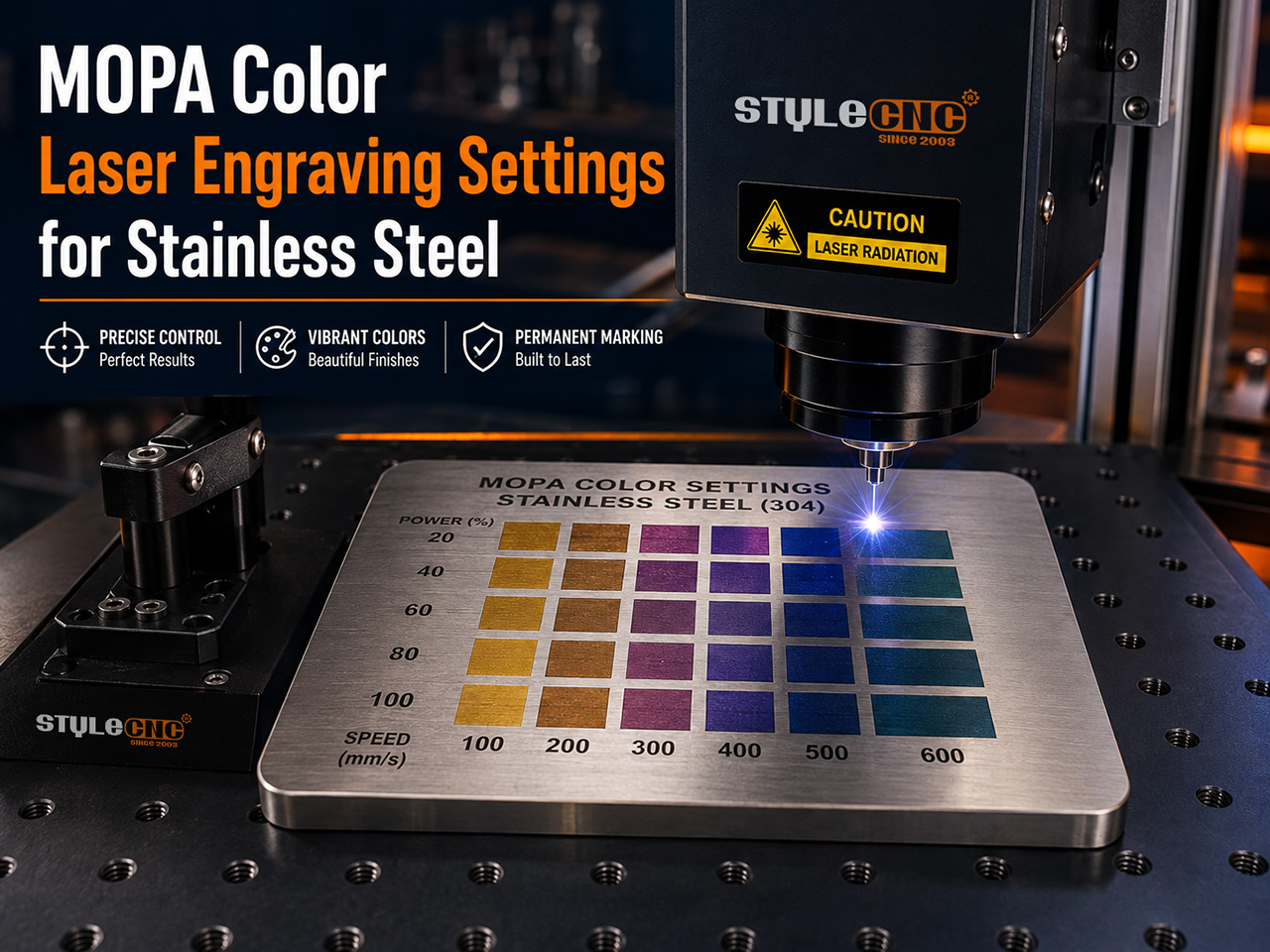
MOPA fiber lasers color stainless steel by growing a thin oxide film whose thickness bends light into a hue. On a 20W source, gold starts near 550 mm/s at 230 kHz with short pulses, while deep blue sits near 250 mm/s at 80 kHz with long pulses. Exact values are machine specific, so run a color test matrix first.

Ask any marking shop which capability sells itself, and colored stainless usually tops the list. Within the 光纤激光打标机 family, MOPA sources are the color specialists, and this guide turns their 4 key settings into repeatable hues.

MOPA Color Laser Engraving Settings for Stainless Steel

Why MOPA Sources Produce Color

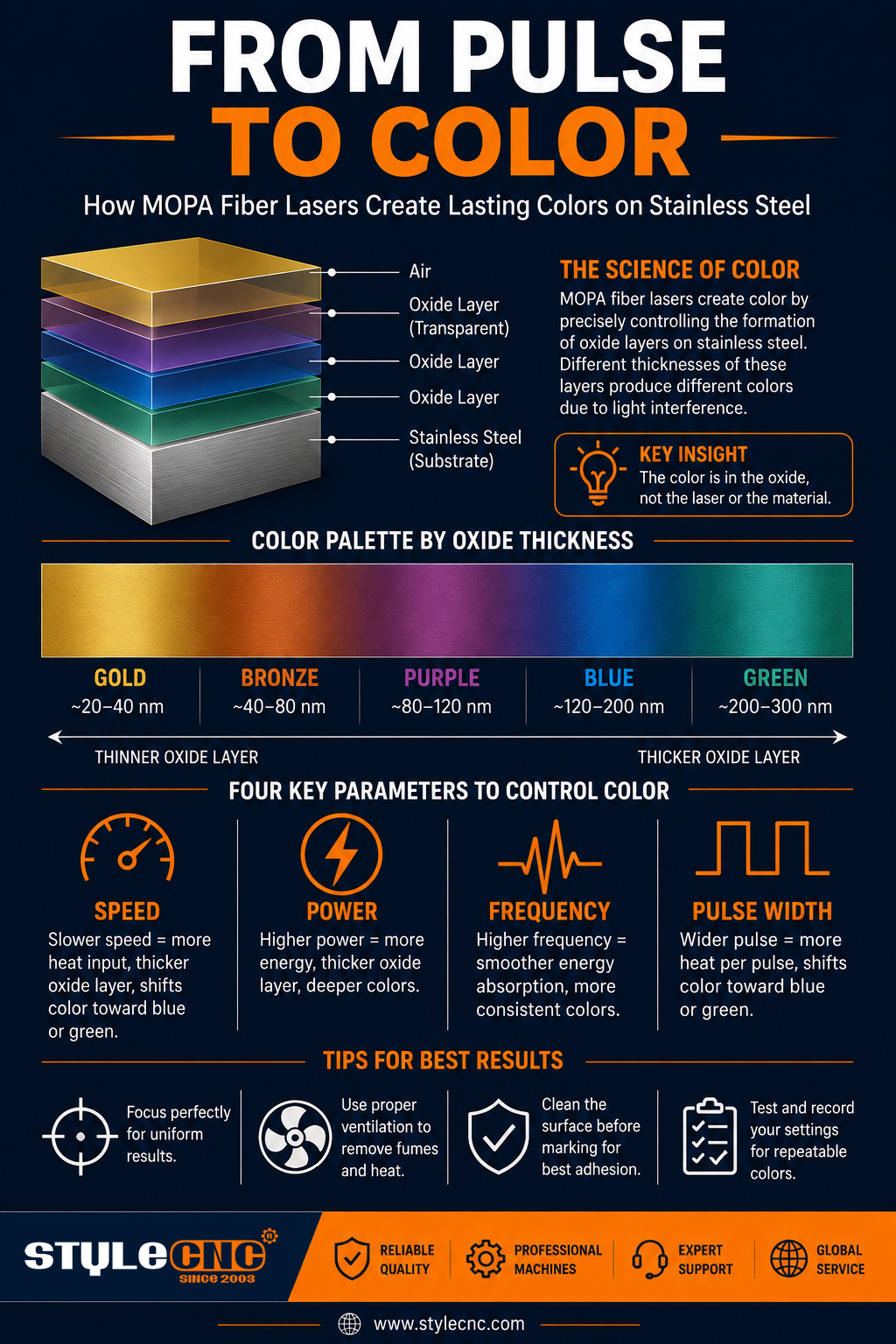
Color on stainless is not ink or coating. The beam grows a transparent chromium oxide film a few tens of nanometers thick, and light interfering inside that film returns a specific hue, the same physics that paints oil slicks.

Film thickness tracks the exact temperature curve at the surface, which is why pulse control matters so much. A MOPA source lets you set pulse duration and pulse frequency independently, giving fine command over that curve.

That control is the whole story behind dedicated hardware such as the color laser marking machine with a MOPA fiber source 紧凑 MOPA光纤激光打标机: repeatable colors need repeatable pulses.

The 4 Variables That Decide the Hue

Speed sets dwell time, power sets peak energy, frequency sets how often pulses land, and pulse width sets how long each one lasts. Together they decide the accumulated heat that grows the film.

2 supporting settings shape the result. Hatch spacing controls saturation, and focal h8 controls everything; half a millimeter of error can move a hue by 2 whole colors.

Research groups such as Fraunhofer ILT have mapped these oxidation windows in detail, and the practical takeaway is simple: change one variable at a time.

MOPA Color Settings Chart for Stainless Steel

The windows below suit a focused 20W MOPA source with a 110 mm field lens on mirror-finish 304 plate, single pass. Treat them as first-grid coordinates rather than final recipes.

颜色速度电力频率脉冲宽度舱口
多维数据监测mm/s额定输出百分比千赫nsmm between fill lines
黄金500-60030-40200-260140-2000.010
Bronze brown400-50035-45160-220180-2400.010
紫色300-38040-50100-150240-3000.010
深蓝200-28045-5560-100300-3800.008-0.012
浅蓝150-22050-6045-70380-4500.008
Green (hardest)120-18055-6540-60420-5000.006-0.010
深黑色100-18055-7040-60220-300, slight defocus0.010

Larger lenses, higher wattages, brushed finishes, and grade changes all shift every window. Colors read differently under warm shop lighting, so judge results in daylight.

值得记住的关键数字

• MOPA pulse widths adjust from roughly 2 to 500 ns, while Q-switched sources sit near a fixed pulse class.

• The oxide films behind these hues measure only tens of nanometers, thinner than a soap bubble wall.

• A focus error of 0.5 mm is enough to swap one color for its neighbor.

• Hatch spacing between 0.006 and 0.020 mm covers most saturated fills.

• Grades 304 and 316 hold slightly different palettes; ASM International documents the chromium and nickel differences behind that.

• STYLECNC的画廊 MOPA marking results on steel shows how mirror and brushed surfaces carry the same recipe differently.

How to Run a Color Test Matrix

Fix power at a middle value, then build a grid with frequency stepping down the rows and pulse width stepping across the columns. Twenty 5 squares of 8 mm each cover a full palette on one offcut.

Clean the plate with isopropyl alcohol and handle it by the edges only. Skin oils are the most common reason a repeat run refuses to match yesterday's colors.

Photograph the finished grid in daylight and log wattage, lens size, plate grade, and focal h8 beside it. A recipe without its context is a coin flip.

Curved work such as colored tumblers and mugs needs a rotary axis so the surface stays at focal h8 while the grid logic stays identical.

Fiber wavelengths are invisible, and polished metal reflects them, so wear glasses rated for 1064 nm that meet Laser Institute of America guidance and keep enclosure interlocks active during every grid.

操作员实际提出的问题

Why does my blue keep drifting into purple?

Purple means the oxide stopped one step short of blue. Slow the head 10 to 15 percent or lengthen the pulse width slightly, and confirm focus before blaming the recipe.

Can a Q-switched fiber laser produce this palette?

Only a narrow slice of it, mostly straw and brown tones, because its pulse width is fixed. The MOPA和Q开关电源的区别 comes down to that one adjustable variable, and color work is where it pays for itself.

Do I lay the color 1st or engrave the logo first?

Run color fills first, then any deep engraving passes. Ablation after color leaves crisp bright edges, while engraving 1st litters the surface with debris that disturbs oxide growth.

Common Mistakes That Ruin the Palette

• Copying recipes across different wattages or field lens sizes.

• Skipping the alcohol wipe; surface oils distort oxide growth.

• Running color jobs even slightly out of focus.

• Using one universal hatch spacing for every hue.

• Ignoring the palette shift between 304 and 316 plate.

• Expecting mirror-plate colors on a brushed or bead-blasted finish.

• Touching fresh marks before the surface has cooled.

• Chasing green 1st instead of dialing in gold and blue as anchors.

Pre-Marking Color Checklist

✓ Wipe the plate with isopropyl alcohol and a lint-free cloth.

✓ Verify exact focal h8 with a test pulse or focus ramp.

✓ Fix power, then grid frequency against pulse width.

✓ Photograph every grid under consistent daylight.

✓ Log lens size, wattage, and material grade with each recipe.

✓ Re-run the matrix whenever the plate supplier changes.

✓ Seal outdoor or dishwasher parts with a clear coat after marking.

MOPA Laser Color Engraving Settings for Stainless Steel

常見問題解答

The questions below recur across marking and maker communities; answers are condensed for quick reference.

Why do published MOPA recipes never match my machine?

Color depends on total heat input, and that shifts with source wattage, lens size, beam quality, and even plate grade. A recipe is a neighborhood, not an address. Fix power, grid frequency against pulse width on your own plate, and the palette appears within a few squares.

What pulse width should I start with for blue?

上 20W source, try 300 to 380 ns with frequency near 60 to 100 kHz and speed around 250 mm/s. If purple appears instead, the energy is slightly short, so slow down or lengthen the pulse one step and rerun the row.

Does wattage change the recipe, or only the speed?

Both. A 60W or 100W source reaches the same oxide temperature far faster, so every value shifts: higher speeds, shorter dwell, often different frequencies. Never scale a 20W chart linearly; run a fresh matrix whenever the source, lens, or plate grade changes.

Can the same settings color titanium?

Titanium colors even more readily than stainless because its oxide grows quickly and evenly, which is why jewelers prize it. The hues arrive at lower energy, so start faster and cooler than your stainless recipe, then walk the grid toward blues and purples.

Why is green so hard to hit?

Green sits in a narrow oxide thickness band between blue and the greys, so a tiny overshoot skips straight past it. Tight focus, fine hatch, and small pulse width steps matter most. Many operators accept a teal compromise rather than chase pure green.

Do the colors survive dishwashers on tumblers?

The oxide itself is hard and food safe, but hot detergent cycles gradually dull saturation, and hand oils shift hue over time. For drinkware that gets daily washing, mark the design, verify the color, then add a food-safe clear coat for insurance.

Should I mark parts before or after fabrication?

After, whenever possible. Bending, welding heat, and passivation baths all disturb the oxide film and can wipe or shift a finished color. If marking must come first, keep designs away from bend lines and mask them during any downstream chemical process.

Why did every color shift when I changed the field lens?

A larger lens spreads the same pulse over a bigger spot, cutting energy density, so each hue now needs more dwell. Treat a lens swap like a new machine: keep the old chart for reference and rerun the matrix at the new focal length.

Do cups and rings need a rotary axis?

Yes, for anything beyond a small flat panel on the curve. Color is focus-critical, and a cylinder falls out of the sweet spot within a few millimeters of arc. A rotary keeps the surface at constant h8 so the hue stays even around the part.

延伸阅读

以下材料不宜激光切割(请用这些材料代替)

2026-08-21上一篇

没有下一篇文章

相关主题

如何用 DVD-ROM 制作迷你激光雕刻机套件?
2023-08-316-Minute Read

如何用 DVD-ROM 制作迷你激光雕刻机套件?

您是否正在打造自己的迷你激光切割雕刻机?查看本 DIY 指南,了解如何使用 DVD-ROM 制作小型激光雕刻机套件,包括零件组装、软件安装和调试以及机械加工操作。

激光雕刻保温杯生意:开启一份有利可图的副业
2026-06-115-Minute Read

激光雕刻保温杯生意:开启一份有利可图的副业

一家激光雕刻保温杯公司使用带有旋转附件的光纤激光打标机,为不锈钢保温杯、水瓶、酒杯和马克杯提供永久性个性化雕刻服务。空白保温杯的成本为 4 至 10 美元,个性化定制的保温杯售价为 25 至 60 美元,利润率为 60% 至 100%。80% 都是标准配置。大多数制造商的启动资金为 3,000 至 8,000 美元,月收入可达 2,000 至 8,000 美元,其中玻璃杯的收入几乎占所有收入的 30%。 30% 成功的雕刻店的收入。

STYLECNCiPhone 手机壳激光雕刻机
2023-10-072-Minute Read

STYLECNCiPhone 手机壳激光雕刻机

STYLECNC为您提供专业的数控解决方案,以便您选择合适的激光雕刻机进行 iPhone 外壳雕刻。

50种畅销且利润丰厚的激光雕刻产品
2026-04-027-Minute Read

50种畅销且利润丰厚的激光雕刻产品

发现 50 种利润最高的激光雕刻产品,包括个性化礼品、家居装饰品、珠宝和定制配饰,这些产品都具有很高的利润率。

激光雕刻机如何工作?
2022-07-263-Minute Read

激光雕刻机如何工作?

激光雕刻是利用激光束在物体上雕刻的过程。激光雕刻机的工作原理参考点阵雕刻和矢量切割。

什么是超快激光?
2023-08-258-Minute Read

什么是超快激光?

想要了解用于切割、雕刻、打标和焊接的超快激光吗?查看本指南以了解超快激光的定义、类型、组件、应用、优缺点。

发表评论

1 至 5 星评级

与他人分享你的点子和感受

点击更改验证码