The Ultimate Buyer's Guide to 5-Axis数控Machining

最后更新:2026-07-06 作者 阅读时间:8分钟

5-Axis数控Machining: The Complete Buyer's Guide & Prices

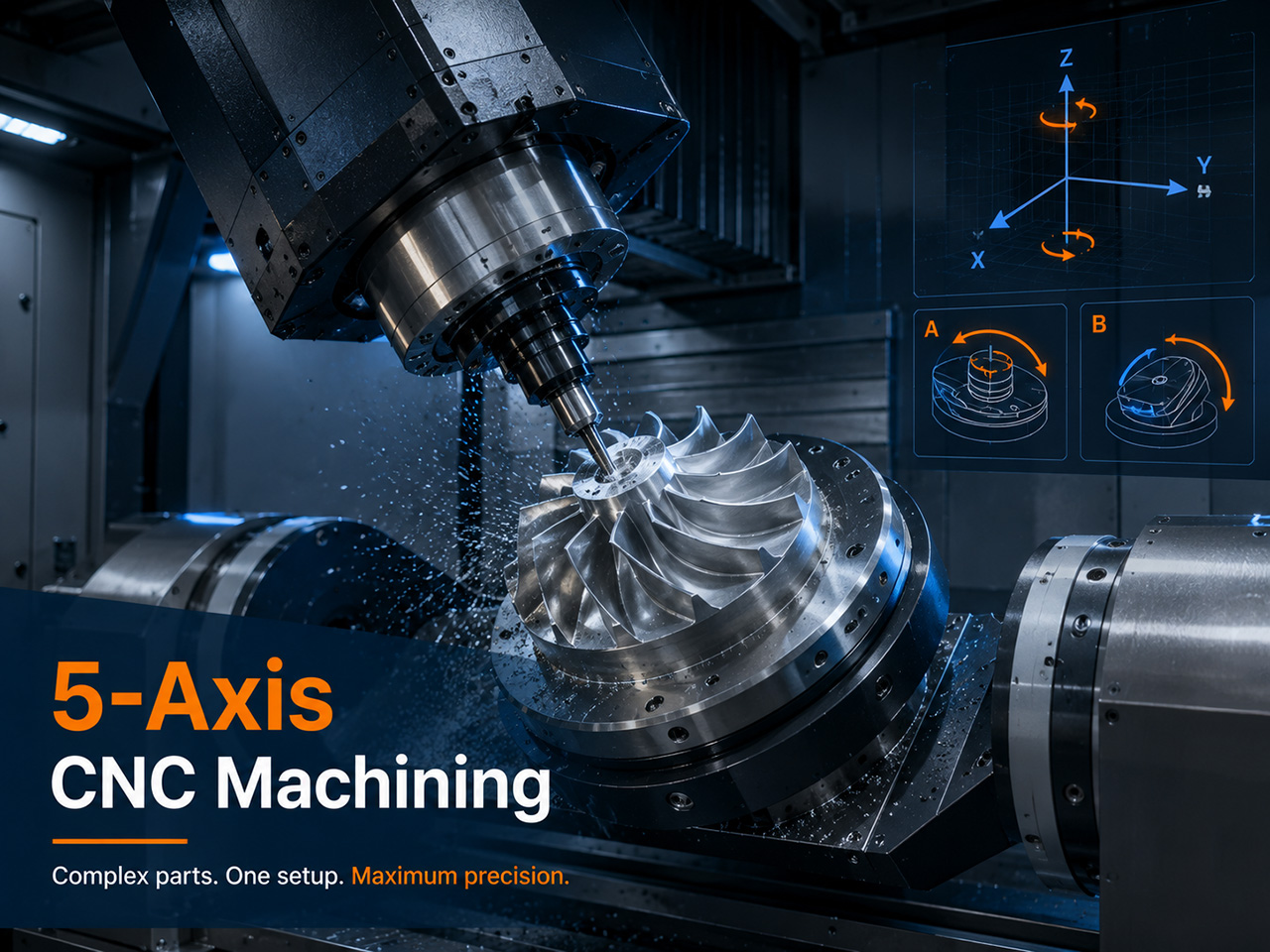
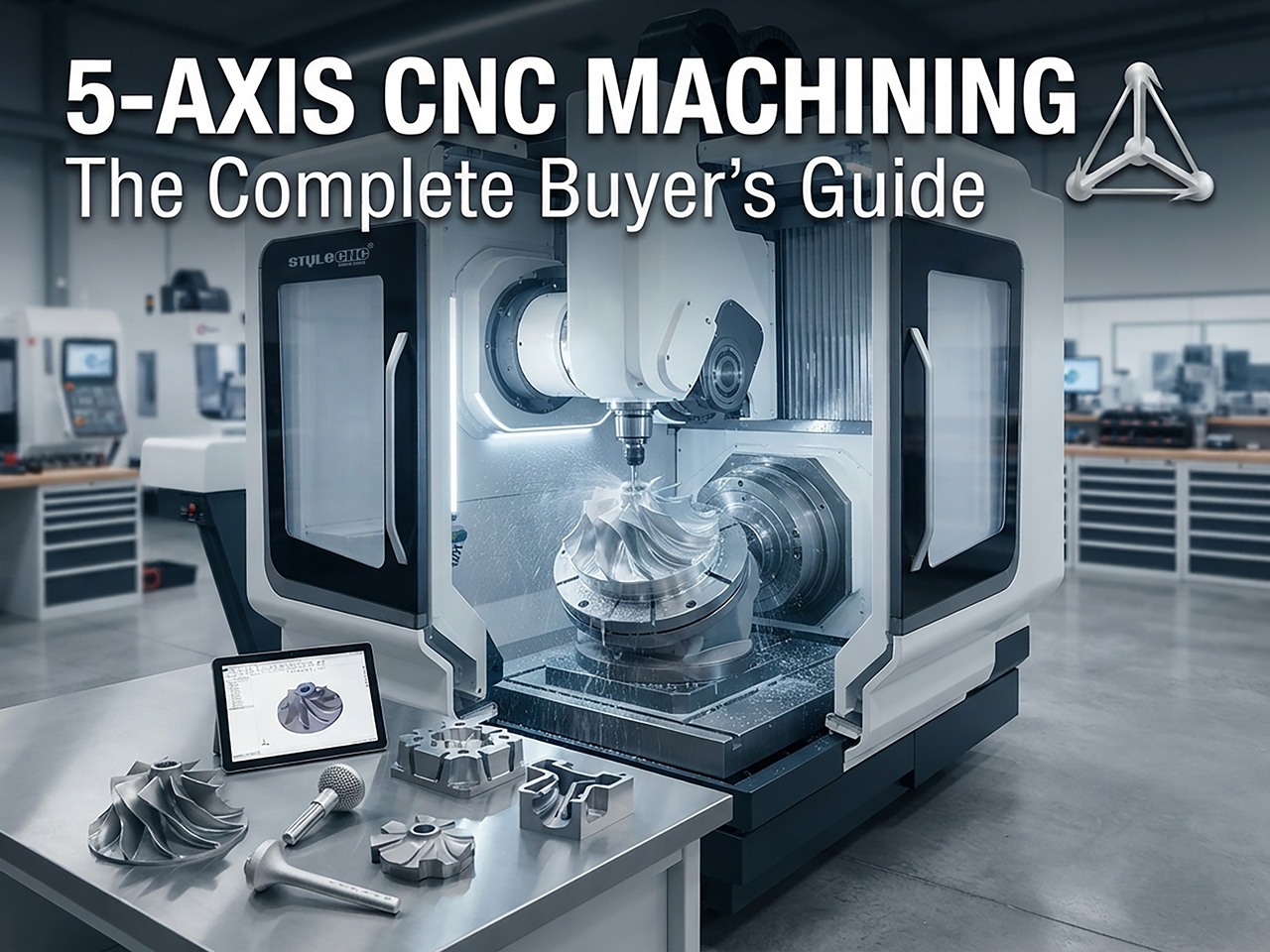
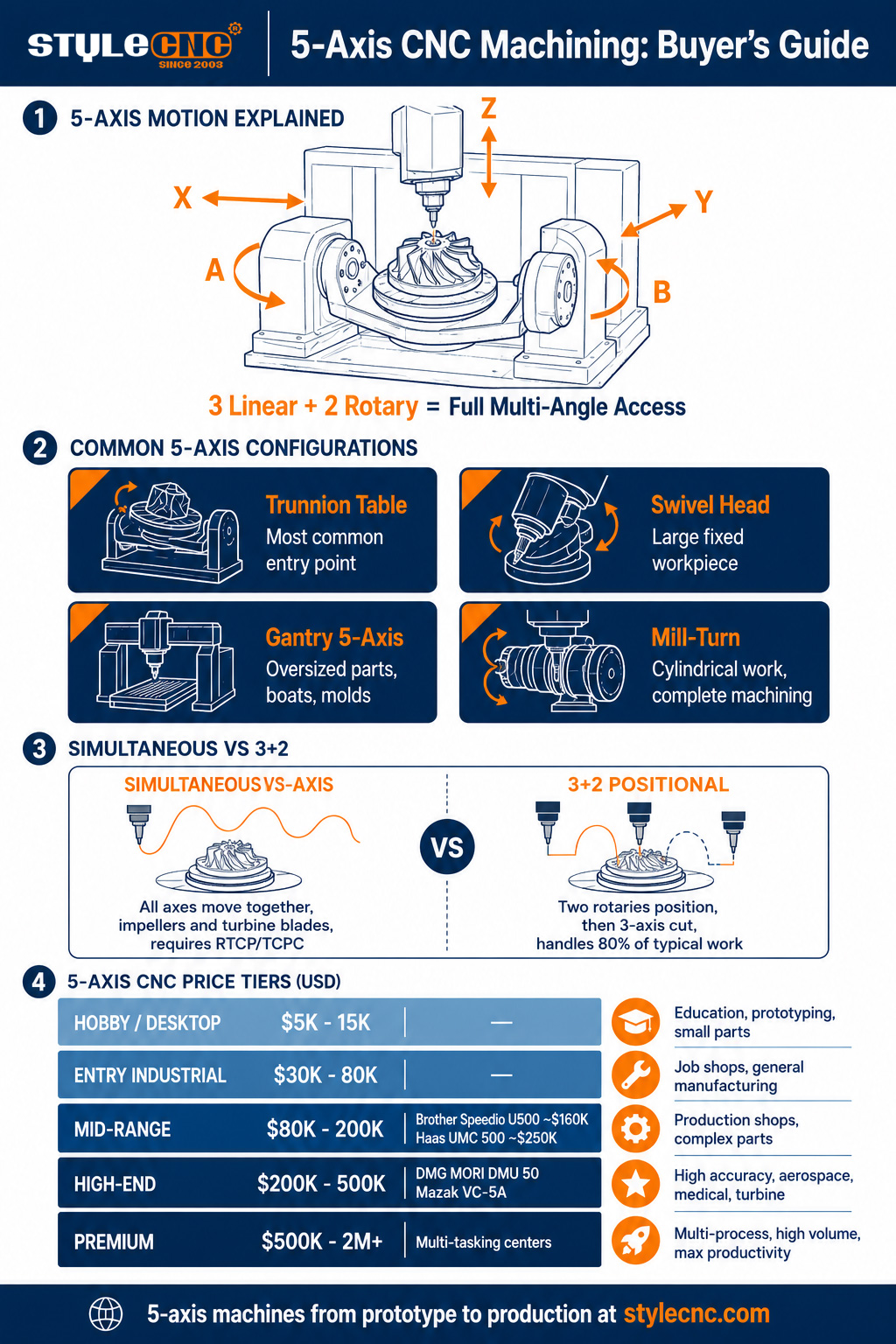
5-axis数控machining is a subtractive process where the cutting tool or workpiece moves along 5 different axes simultaneously: 3 linear (X, Y, Z) plus 2 rotational (typically A and B, or A and C). This lets the machine approach the workpiece from virtually any angle, producing complex geometry in a single setup that would require multiple operations on a 3-axis machine.

The defining feature is the addition of rotational motion. A traditional 3-axis 数控机床 moves the cutter in straight lines along X, Y, and Z. A 5-axis machine adds 2 rotary axes that tilt or rotate either the spindle head, the workpiece, or both. The result is access to undercuts, compound angles, contoured surfaces, and complex pockets that a 3-axis machine simply cannot reach without multiple setups and fixtures.

That single-setup capability is what drives the economics. A part that takes 3 or 4 setups on a 3-axis machine, with re-fixturing between each, can often run complete on a 5-axis machine in one clamping. Cycle times drop. Accuracy improves because re-fixturing errors are eliminated. Labor costs drop because operators are not setting up the same part repeatedly. For shops doing low-volume, high-complexity work, this is the entire business case for upgrading.

5-Axis数控Machining: The Complete Buyer's Guide & Prices

The 5 Axes Explained: X, Y, Z, A/B, and C

Every 5-axis machine combines the 3 standard linear axes with 2 of 3 possible rotary axes. The breakdown below shows what each axis does and how they typically combine in production machines.

运动类型描述常见于
X直排式Left-right movement of cutter or tableEvery数控machine
Y直排式Forward-backward movementEvery数控machine
Z直排式Up-down movement (spindle depth)Every数控machine
ARotary around XTilt motion around the X-axisTrunnion-table 5-axis, gantry 5-axis routers
BRotary around YTilt motion around the Y-axisSwivel-head 5-axis, mill-turn centers
CRotary around ZRotation around the Z-axis (spinning the table)Trunnion-rotary table, turn-mill machines

The 5-axis name describes the count, but the specific combination matters. The 2 most common production configurations are XYZAB (linear plus 2 head-tilt rotaries) and XYZAC (linear plus one head-tilt and one table-rotation). A 3rd configuration, XYZBC, is common on mill-turn machining centers where the workpiece spins on C while the head tilts on B. Each layout has different reach, rigidity, and program complexity characteristics.

5-Axis vs 3-Axis CNC: The Commercial Decision

Choosing between 3-axis and 5-axis is a capital expenditure decision driven by the part mix, not by the capability claim. The comparison below summarizes the practical differences buyers should weigh.

因素五轴数控五轴数控
Setups per complex part3 to 5 typical1 setup typical
工具范围仅自上而下Any approach angle
Surface finish on contoursStep-over visibleSmoother with side-cutter access
编程复杂度简易Requires 5-axis CAM and post
Fixturing cost per jobHigh (multiple fixtures)Low (one fixture)
操作员技能要求标准机械师5-axis trained programmer/operator
Entry-level price5,000 30,000美元30,000 200,000美元
Industrial production price50,000 200,000美元200,000 至 500,000 美元以上
最合适Prismatic parts, sheet stock, 2.5D workAerospace, mold, medical, multi-face complex parts

5-Axis Configurations: Trunnion, Swivel Head, Gantry, and Mill-Turn

Not all 5-axis machines are built the same. The 4 dominant configurations have different strengths, and the choice between them is a of the most consequential decisions in the buying process.

耳轴台

A rotary table mounted on a tilting trunnion provides the A and C axes while the spindle remains in its standard 3-axis configuration. The workpiece tilts and rotates beneath a fixed-orientation spindle. This is the most common entry into 5-axis machining because it preserves the rigidity and accuracy of a standard machining center while adding the 2 rotaries. Best for parts that fit within the trunnion swing envelope.

Swivel head (double swing-head)

The spindle head itself tilts and rotates while the workpiece stays fixed on the table. This is the dominant configuration for very large parts that cannot rotate, including aircraft structural components, large molds, and oversized aerospace fixtures. RTCP compensation in the controller is essential because the tool tip position depends on head orientation.

Gantry 5-axis

A gantry-frame machine with a swivel head, scaled up to accommodate very large workpieces. Used for boat hulls, aerospace structural assemblies, large foam molds for automotive prototyping, and stone bridge-cutting. STYLECNC5-axis gantry routers fall in this category, with work envelopes ranging from 4-foot square 业余爱好formats up to multi-meter industrial configurations.

Mill-turn / turn-mill center

A turning lathe with a milling spindle that can tilt (B-axis) and a workpiece that rotates (C-axis), often combined with sub-spindle and live tooling. These are the most expensive 5-axis configurations because they combine turning and milling in a single machine, but they eliminate part-handling between operations entirely on cylindrical work.

The Ultimate Buyer's Guide to 5-Axis数控Machining

Simultaneous 5-Axis vs 3+2 Positional Machining

One of the most consequential technical distinctions in 5-axis machining is between simultaneous and 3+2 positional operation. Buyers often discover this difference only after they have written a purchase order, and the gap matters.

同步五轴加工 moves all 5 axes at the same time during the cut. The tool tip follows a continuous path while the rotaries are constantly adjusting orientation. This is required for impellers, turbine blades, sculpted mold surfaces, and any organic contoured geometry. Simultaneous operation requires RTCP (Rotated Tool Center Point) or TCPC (Tool Center Point Control) in the controller. Without RTCP, the controller cannot maintain the programmed tool tip path while the rotaries move, and the part will not match the CAM simulation.

3+2位加工 uses the 2 rotary axes to position the workpiece (or head) at a fixed angle, then performs standard 3-axis machining at that orientation. This handles roughly 80 percent of typical 5-axis shop work and is significantly easier to program. Practical Machinist contributors who run mixed 5-axis fleets consistently note that most of their daily work is 3+2 rather than full simultaneous, with simultaneous reserved for specific geometry that demands it.

The practical buying implication is significant. A machine with 5 physical axes but no RTCP is sometimes called a 3+2 machine rather than a true 5-axis machine. It can position the tool but cannot maintain a continuous tool tip path while moving all 5 axes. When evaluating a 5-axis purchase, confirming RTCP/TCPC support on the controller (FANUC G43.4, Heidenhain M128, Siemens TRAORI, or equivalent) is essential. This is the difference between a machine that can machine an impeller and one that cannot.

5-Axis数控Applications: Industry Gallery

5-axis数控machines have established footholds in 4 primary verticals, each with specific geometric or material requirements that justify the capital investment.

INDUSTRY: Aerospace

Aerospace was the 1st vertical to adopt 5-axis machining at scale. Engine brackets, turbine blades, impellers, structural ribs, and fittings in titanium and nickel superalloys are the bread-and-butter applications. The geometric complexity (compound curves, internal cooling channels, asymmetric surfaces) and the cost of the material (often hundreds of dollars per kilogram) make single-setup 5-axis machining economically essential.

INDUSTRY: Automotive and Mold-Die

Mold and die work is the second-largest 5-axis application. Injection mold cavities, die-cast tools, and stamping dies benefit from 5-axis side-cutter access to deep cavities that a 3-axis machine cannot reach with reasonable tooling. Automotive prototype car body bucks, foam molds for clay modeling, and large stamping forms also rely heavily on 5-axis routers and machining centers.

INDUSTRY: Medical, Dental, and Jewelry

Medical implants (hip, knee, cranial, dental abutments), surgical instruments, and patient-specific prosthetics all use 5-axis machining for the contoured surfaces required by anatomy. Jewelry production uses small-format 5-axis machines for ring shanks, signet faces, and detail work that requires multi-angle tool access on precious metals. Quality and material costs again drive the economics.

INDUSTRY: Architecture, Stone, and Custom

Architectural stone, monument carving, custom signage, prop and theatrical work, marine prototyping, and bespoke furniture all use large-format 5-axis routers to produce sculpted geometry that no other process can deliver economically at the size involved. The work envelope can range from desktop scale to gantry-class machines spanning multiple meters.

5-Axis数控Price Ranges: 业余爱好to Industrial Production

5-axis数控pricing varies by a factor of 100 across the market. The table below summarizes typical price brackets for new machines, with used and refurbished machines often available at 30 to 60 percent of new-equivalent pricing depending on hours, condition, and brand.

级别价格范围(美元)Typical Use Case and Examples
业余爱好/ Desktop5,000到15,000Jewelry, dental, small prototypes, education. Small-format desktop 5-axis machines.
Entry industrial30,000到80,000Light production, small mold work, custom furniture, jewelry production. Entry-level trunnion-table machines and small gantry routers.
中档工业80,000到200,000Production aerospace brackets, automotive prototype work, mold cavity finishing. Brother Speedio U500 (~160K), Haas UMC 500 (~250K) per Practical Machinist coverage.
高端生产200,000到500,000Multi-tasking machining centers, full-size gantry routers, premium swivel-head machines. DMG MORI DMU 50, DN Solutions DVF 5000 (~300K), Mazak VC-5A 5X.
Premium / Specialty500,000万至2万以上Mill-turn turn-mill centers, large gantry 5-axis, multi-spindle production lines. DMG MORI DMU 75 Monoblock, Mazak Integrex multi-tasking.

Beyond the machine itself, total cost of ownership includes 5-axis CAM software (Mastercam, NX CAM, ESPRIT, PowerMill, typically 5,000 to 50,000 $per seat), simulation software like Vericut (often 25,000 to 50,000 $per seat for full 5-axis verification), tooling and fixtures, operator training, and installation. Plan for 20 to 40 percent of machine cost in surrounding ecosystem on top of the base purchase.

STYLECNC五轴和多任务机床

STYLECNCmanufactures a complete range of 5-axis数控machines across the entry-industrial through high-end production tiers. The 5-axis数控machine category covers gantry routers, milling machines, machining centers, and dedicated configurations for specific work. The 三轴数控铣床五轴数控雕刻机 3D 铣削和雕刻 are the most common starting points for prototype shops, mold work, and architectural production.

For shops focused on precision metalworking, the 五轴数控铣床Small 5-axis数控machining center handle aluminum mold work, aerospace prototyping, and medical-device production. For mold and die shops specifically, the 数控mold making machine category pairs 5-axis surface capability with the rigidity required for hardened tool steel work.

▶ WATCH: 5-Axis数控Router in Action

观看 STYLECNC5-axis数控router producing 3D foam and aluminum work in real production conditions.

View video on stylecnc.com →

STYLECNCalso builds multi-tasking and multi-spindle configurations for production environments where throughput and parallel work matter. The UK delivery of a multi-tasking数控router with 3 spindles is a recent example of an enterprise furniture customer specifying parallel processing on a single bed. For自动换刀integration on either 5-axis or multi-tasking platforms, the 自动换刀数控雕刻机类别 documents the toolchanger options available across STYLECNCmachine lines.

定价 STYLECNC5-axis machines spans the entry-industrial through high-end production tiers covered in the price table above. Configurations are quoted based on work envelope, spindle specification, controller selection,自动换刀capacity, and integration requirements. Contact the STYLECNCsales team with the part envelope and material list for a configured quote.

5-Axis数控Machining Buyer's Guide

Glossary: 5-Axis数控Terms

Use this reference when evaluating 5-axis machines, talking with vendors, or reviewing controller documentation.

术语定义
三轴数控Machine with 3 linear axes (X, Y, Z) plus 2 rotary axes (typically A and B, or A and C).
耳轴台Tilting rotary table providing 2 rotary axes beneath a fixed-orientation spindle.
旋转头Spindle head that tilts and rotates while the workpiece remains fixed on the table.
RTCP / TCPC / TCPMRotated Tool Center Point / Tool Center Point Control / Tool Center Point Management. Controller feature that maintains tool tip position during rotary motion.
联动5轴All 5 axes move together during the cut, following a continuous tool tip path.
3+2 (positional)2 rotary axes position the part at a fixed angle, then standard 3-axis machining proceeds.
后处理器Software that translates CAM toolpaths into the specific G-code dialect the machine controller understands.
Mill-turn / turn-millMachine that combines lathe turning with milling, typically with B-axis spindle and C-axis spindle.
Kinematics fileMathematical model of how the machine's axes physically move relative to each other.
Multi-tasking centerMachine that combines multiple operations (turning, milling, drilling, sometimes additive) in a single setup.

常見問題解答

What is the difference between RTCP and TCPC?

RTCP (Rotated Tool Center Point), TCPC (Tool Center Point Control), TCPM (Tool Center Point Management), and RPCP refer to the same fundamental controller feature: automatically maintaining the programmed tool tip position when the rotary axes move. The term varies by builder. FANUC uses G43.4 (TCPC), Heidenhain uses M128 (TCPM), Siemens uses TRAORI. As discussed in the Practical Machinist "Fanuc TCPC for 5-axis machining" thread, the function is what makes simultaneous 5-axis programming practical rather than the brand-specific name.

Do I need simultaneous 5-axis or is 3+2 enough?

Practical Machinist contributors running mixed 5-axis fleets consistently note that roughly 80 percent of their work is 3+2 positional rather than full simultaneous. Aerospace structural parts, mold cavity finishing, multi-face brackets, and most 5-sided machining work all run as 3+2. Simultaneous machining becomes essential for impellers, turbine blades, organic contoured surfaces, and any geometry that requires continuous tool tip path control across multiple axes.

一台五轴数控机床要多少钱?

Pricing ranges from 5,000 to 15,000 $for desktop 业余爱好formats, 30,000 to 80,000 $for entry industrial machines, and 80,000 to 200,000 $for mid-range production. Practical Machinist threads on the Brother Speedio U500 cite roughly 160,000 USD, the Haas UMC 500 around 250,000 USD, the DN Solutions DVF 5000 around 300,000 USD, and DMG MORI 5-axis machines often above 500,000 USD. Premium mill-turn multi-tasking centers exceed 1 million USD.

Is a used 5-axis machine a good buy?

Discussion on the Practical Machinist "15 year old German 5 axis machines" thread frames the trade-off honestly. Used DMG, Mikron, and Hermle machines at 100,000 $can deliver new-equivalent of 300,000 to 500,000 $if the spindle, controller, and rotaries are in good condition. The risk is electronics availability and spindle wear. The common rule of thumb cited in those threads is roughly one $per RPM for a spindle rebuild, which on a 30,000 to 50,000 RPM machine is significant. An independent technical inspection before purchase is standard practice.

Can a 3-axis machine be converted to 5-axis?

Partially. A 5-axis trunnion table can be added to a 3-axis vertical mill to provide A and C rotaries, as discussed on the Practical Machinist "Setup methods for 5 axis work offsets" thread. The limitation is that without RTCP in the host controller, the conversion produces a 3+2 capability rather than full simultaneous machining. The cost of adding TCPC to a controller that does not have it natively can exceed 20,000 USD, which is part of why many shops eventually buy a purpose-built 5-axis machine instead of expanding a 3-axis one.

What post-processor do I need for 5-axis CNC?

5-axis post-processors must match the controller, the kinematics, and the CAM software. The CNCZone "5 axis 数控雕刻机 RTCP" thread documents the difficulty of getting a custom post to work correctly: small kinematics errors, unit mismatches, or incorrect tool length values produce gouges and crashes that simulation will not catch unless the simulation model exactly matches the machine. Most production shops buy a vendor-supplied post from the machine builder or CAM provider rather than attempting custom post development.

延伸阅读

人工智能驱动的数控加工:智能制造完整指南

2026-07-02上一篇

没有下一篇文章

相关主题

CNC加工利弊入门指南
2026-03-208-Minute Read

CNC加工利弊入门指南

数控加工是一种计算机辅助制造工艺,用于加工各种材料(从金属到塑料甚至木材)的精密零件。本入门指南将详细介绍什么是数控加工、数控加工的工作原理、数控加工的类型和工艺流程,以及它相对于手工加工和其他制造方法的优势。您还将了解到为什么从航空航天到医疗保健等众多行业都依赖于数控加工。在了解其优势的同时,我们也列出了其常见的缺点,以便您在购买或操作数控机床时注意这些缺点。

数控铣床 VS 数控加工中心 VS 数控雕刻机
2022-11-253-Minute Read

数控铣床 VS 数控加工中心 VS 数控雕刻机

您是否正在寻找用于木工或金属加工的数控铣床、数控加工中心或数控雕刻机?查看本指南以比较 3 种最常见的机床类型,这有助于您通过智能自动化制造开展业务。

如何利用数控机床和激光技术创办定制奖杯和奖品业务
2026-05-306-Minute Read

如何利用数控机床和激光技术创办定制奖杯和奖品业务

定制奖杯和奖品业务每月通过服务学校、体育联盟、企业客户和活动组织者,创造 3,000 至 10,000 美元的收入。启动资金(例如购置一台光纤激光打标机)约为 3,000 至 10,000 美元。 CO2 激光雕刻机、基础材料和简单的线上平台。55%到75%的利润率源于低廉的材料成本(亚克力、木材、玻璃坯料)与个性化识别产品的高感知价值之间的差距。

普通铣刀可以在数控机床上使用吗?
2023-09-046-Minute Read

普通铣刀可以在数控机床上使用吗?

您可以使用普通铣刀代替数控机床(如铣床和车床)中的车削刀具和铣刀吗?阅读本指南以了解如何在机床中选择和使用铣刀。

五轴数控雕刻机主要用于哪些用途?
2021-08-312-Minute Read

五轴数控雕刻机主要用于哪些用途?

五轴数控雕刻机旨在为木材、塑料、金属和其他复合材料等多种材料提供高速和高质量的切割。

如何将你的数控加工副业发展成全职收入:实用指南
2026-05-197-Minute Read

如何将你的数控加工副业发展成全职收入:实用指南

想把你的数控加工副业发展成全职收入吗?学习定价公式、盈利细分市场、销售渠道和系统,从而取代你的日常工作薪水。

发表评论

1 至 5 星评级

与他人分享你的点子和感受

点击更改验证码